Is Gaming Actually Good for You? We Read the Science So You Don't Have To
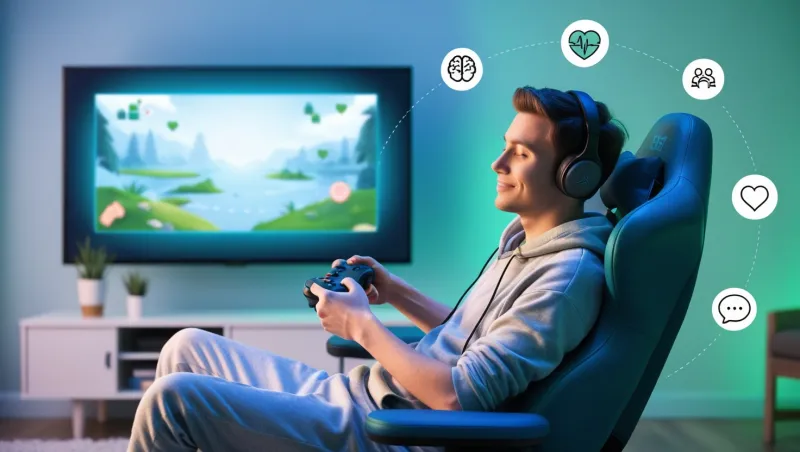
Photo: person relaxed gaming couch happy stress relief, via blogger.googleusercontent.com
Every few months, a new headline arrives with the energy of a disappointed parent standing in a doorway: "Study Links Gaming to Attention Problems." "Screen Time Destroying Young Minds." "Video Games: Digital Crack or Just Regular Crack?" (Okay, we made that last one up, but barely.)
And look, we get it. The concern isn't entirely without merit. Like most things that feel good, gaming can be overdone. But the doom-and-gloom narrative that gets recycled in mainstream media tends to leave out a significant chunk of what the research actually shows—the part where gaming, done in reasonable amounts, delivers some legitimately impressive benefits for your brain and your mental health.
So let's actually look at the science. Not the cherry-picked panic version. The real, peer-reviewed, published-in-actual-journals version.
What the Research Gets Right About Gaming Benefits
Start with cognitive function, because that's where the evidence is most robust. A 2022 study published in JAMA Network Open analyzed data from nearly 2,000 children and found that kids who played video games for three or more hours per day performed significantly better on cognitive tests measuring impulse control and working memory than non-gamers. The researchers were careful not to overstate causation, but the correlation was hard to ignore.
Action games specifically have been studied extensively at the University of Rochester, where researchers found that players of fast-paced games showed measurable improvements in visual attention, processing speed, and the ability to track multiple objects simultaneously. These aren't trivial skills. They're the same skills that pilots, surgeons, and air traffic controllers spend years training.
Problem-solving is another area where gaming earns its keep. Strategy games—your Civilization titles, your Into the Breach, your tower defense obsessions—require players to manage competing priorities, plan multiple moves ahead, and adapt when plans fall apart. That's not brain rot. That's executive function training with better graphics.
The Anxiety and Mood Angle (This One's Interesting)
Here's where things get a little more nuanced, and a little more personally relevant for a lot of players.
Research published in the American Journal of Psychiatry found that moderate gaming was associated with lower levels of depression and anxiety in adolescents. A separate study out of Oxford's Internet Institute found that adults who played games like Animal Crossing reported higher levels of wellbeing than non-players—a finding that made headlines partly because it was Oxford, and partly because Animal Crossing is about befriending cartoon raccoons, which feels like it shouldn't count as therapy but apparently kind of does.
The mechanism here isn't magic. It's flow state—the psychological concept of being fully absorbed in a challenging but manageable task. Games are uniquely good at inducing flow because they're designed to do exactly that: give you a clear goal, calibrate the difficulty to your skill level, and provide immediate feedback. Therapists have been using this framework for decades. Games just happen to deliver it in a format that's also fun.
There's also the social component, which gets underestimated constantly. Multiplayer gaming—whether cooperative or competitive—provides a structured social environment that many people find easier to navigate than unstructured real-world socializing. For folks dealing with social anxiety, gaming communities can be genuine on-ramps back to human connection. That's not a small thing.
Okay, But What About the Legit Concerns?
Fair question. The science doesn't give gaming a blanket gold star, and pretending otherwise would be its own kind of misinformation.
Addictive-style gaming—characterized by loss of control, continued use despite negative consequences, and prioritizing gaming over basic needs—is a real phenomenon. The WHO added "gaming disorder" to its International Classification of Diseases in 2018, though it's worth noting that researchers estimate this affects somewhere between 1-3% of gamers. That's meaningful, but it's not the epidemic the headlines imply.
Sleep disruption is a legitimate concern, particularly for late-night sessions with high-stimulation games. Blue light exposure aside, the psychological arousal from competitive or horror games can genuinely delay sleep onset. This matters because sleep is where your brain does a lot of its maintenance work, and chronically shorting it has cascading effects on mood, cognition, and physical health.
There's also the question of which games you're playing. A 2021 study in Computers in Human Behavior suggested that games with highly randomized reward systems—think loot boxes, gacha mechanics, certain mobile games—activate dopamine pathways in ways that more closely resemble gambling than traditional play. That's a design issue as much as a gaming issue, but it's worth being aware of what you're actually engaging with.
So Which Games Are Actually Good for You?
Based on the research, here's a rough framework:
Likely beneficial: Action-adventure games with problem-solving elements, strategy games, cooperative multiplayer, narrative games with emotional depth, rhythm games, puzzle games. These tend to combine cognitive engagement, social connection, or creative expression in ways the research consistently validates.
Probably neutral: Most casual games, sports simulations, relaxed open-world exploration. Fine in moderation, not particularly enriching or harmful.
Worth watching: Games with aggressive monetization tied to randomized rewards, highly competitive titles that spike your cortisol without offering flow state (because you're stuck in a losing streak spiral), and anything you're playing past the point where it's actually fun.
That last one is the most important metric. If a game is stressing you out more than it's entertaining you, that's information. The research on gaming benefits almost universally applies to gaming that people are enjoying. Grinding through content you hate because of sunk cost isn't flow state—it's just suffering with better graphics.
The Takeaway: Gaming Is a Tool, Not a Verdict
The "gaming is bad for you" narrative and the "gaming is basically medicine" counter-narrative are both doing the same thing: flattening a complex, varied activity into a simple verdict. The truth is that gaming is a tool, and like most tools, what matters is how you use it.
Moderate play of engaging games that you actually enjoy? The science is pretty consistently in your corner. Compulsive play of games designed to exploit psychological vulnerabilities, at the expense of sleep and real-world relationships? Less so.
Most of us already know the difference on some level. The research just gives us permission to trust what we already feel: that play is good for humans, and that games—at their best—are one of the most sophisticated forms of play ever invented.
Now go touch some grass. Then come back and finish that dungeon. The science says it's fine.