Why Do Games Make Us Lose Our Minds? (And Why We Keep Coming Back)
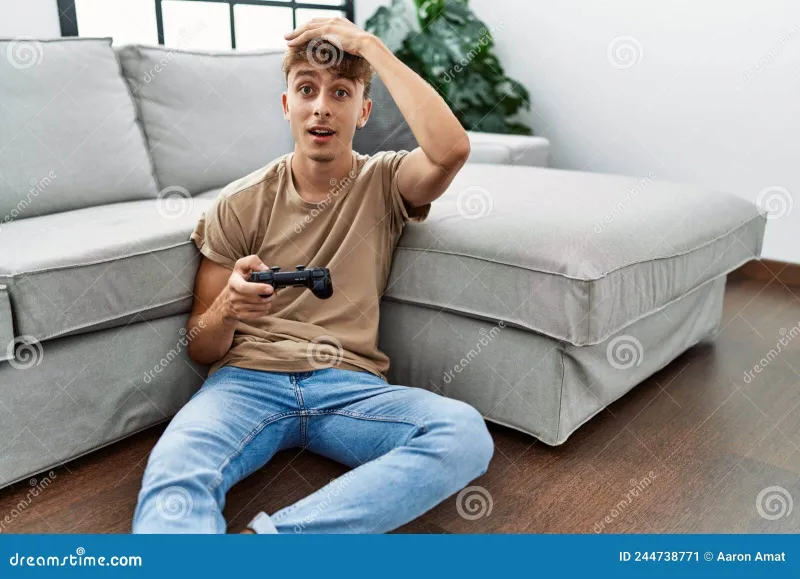
Photo: person frustrated playing video game controller living room, via thumbs.dreamstime.com
Let's establish something immediately: you have, at some point, had a genuinely unhinged reaction to a video game. Maybe you rage-quit a Mario Kart race because some blue shell-wielding gremlin ruined your perfect run with two seconds left. Maybe you threw a controller. Maybe — and this is a safe space — you yelled something at a television that you would prefer never to be repeated in polite company.
You're not broken. You're not immature. You're actually, according to science, responding in a deeply human way to a very specific kind of frustration. That doesn't make the controller-throwing okay, but it does make it understandable.
So let's talk about why games make us absolutely unravel — and why some of them are genuinely brilliant at making you furious in a way that feels good.
Your Brain on a Losing Streak
Here's the thing about gaming frustration: it's not random. It follows a pretty predictable psychological pattern, and once you understand it, you'll recognize it happening to you in real time. (Whether that helps you stop screaming is a separate question.)
When you're gaming, your brain is running a continuous prediction engine. Every action you take, it's generating an expectation of what should happen next. Land the jump. Hit the enemy. Make the shot. When those predictions are confirmed — when the jump lands perfectly — your brain releases a small hit of dopamine. It feels good. You want more.
When those predictions are wrong, though? When you fall off the platform for the tenth time in a row, or when the enemy does something you didn't see coming and kills your character? Your brain registers that as a threat. Not metaphorically — neurologically. Your amygdala, the part of your brain that handles emotional responses, kicks in the same way it would if something genuinely threatening happened to you. Your heart rate climbs. Your muscles tense. Stress hormones get involved.
You're not "being dramatic." Your nervous system is treating a video game loss as a legitimate crisis. Which is, objectively, a little embarrassing for all of us, but here we are.
The technical term for the experience that triggers all this is called "loss aversion" — we feel losses more intensely than equivalent gains. Winning a round feels nice. Losing a round feels terrible. Games that pile on losses without sufficient reward cycles are essentially just stress machines with better graphics.
The Difference Between Good Hard and Just Plain Mean
Not all gaming frustration is created equal, and this is where things get genuinely interesting.
There's a version of difficulty that feels punishing but fair — where you die, you understand exactly why you died, and you feel a clear path toward doing better. Dark Souls is the classic example. The game is brutally difficult, and yet it has a passionate, devoted fanbase because every death teaches you something. The information you need to succeed is always present in the world. When you finally beat a boss that's been destroying you for an hour, the feeling is euphoric in a way that easier victories simply aren't.
Then there's the other kind of difficulty. The kind where you die and you genuinely cannot identify what you did wrong. Where the enemy's attack had no visible telegraph. Where the collision detection is slightly off, or the camera betrayed you at the worst possible moment. This is what players mean when they call a game "unfair" — not that it's hard, but that it's arbitrary. The game isn't testing your skill. It's just being chaotic, and your failure feels random rather than instructive.
Game designers talk about this constantly. The goal of good difficulty design isn't to make players feel stupid. It's to make them feel capable — just barely capable, in a way that requires growth. That razor-thin edge between "I can do this" and "this is impossible" is called the "flow state," and games that nail it are the ones you can't put down even when they're making you miserable.
Hall of Fame: Games That Get the Fury Right
Celeste is practically a masterclass in this. It's a platformer that will kill you hundreds of times, but it also checkpoints generously, respawns you instantly, and makes each attempt feel like a fresh shot at redemption. The game respects your time even while testing your patience.
Hades cracked the code in a different way — by making failure narratively interesting. Every run you don't complete still advances the story. Your character has something new to say. The world reacts to your death in a way that makes it feel like progress rather than punishment. It's genius, honestly.
Even Elden Ring, which will absolutely humble you repeatedly, gives you enough agency to choose your battles and grind your way to viability. The frustration is real, but it's never hopeless.
Practical Tips for Keeping Your Controller Intact
Okay, science aside — what do you actually do when you feel the rage spiral starting?
The two-death rule. If you've died to the same obstacle twice in a row, take a five-minute break before the third attempt. This sounds small but it's genuinely effective. You come back with fresh pattern recognition and lower cortisol levels.
Change something, anything. If you've been approaching a challenge the same way repeatedly, your brain is stuck in a loop. Try a different strategy, a different route, different equipment. The act of changing your approach breaks the emotional pattern even if the new approach doesn't immediately work.
Lower the difficulty and feel zero shame. This is a hill worth dying on: there is nothing wrong with adjusting difficulty settings. Games have them for a reason. The story doesn't care. The developers don't care. The only person judging you is you, and you should tell that person to relax.
Recognize the sunk cost trap. "I've been trying this for an hour, I can't stop now" is how you end up playing an unfun game at 2 AM in a genuine emotional crisis. Walk away. The save file will be there tomorrow.
The Beautiful Absurdity of Coming Back
Here's the part that's genuinely funny about all of this: we know games make us frustrated, and we play them anyway. We seek out the ones that are going to stress us out, because when the challenge-reward cycle is calibrated correctly, that frustration is actually fun. It's the same reason people ride roller coasters and watch horror movies — controlled stress, in a safe environment, followed by relief, is genuinely pleasurable.
Games figured this out decades ago. We're just now getting the neuroscience to explain why your hands are shaking after a boss fight and you loved every second of it.
So next time you feel the rage building — and you will — just know that your brain is doing exactly what brains do. Take a breath. Put the controller down gently. And maybe, just maybe, try one more time.